LEADERIAL makes the interplay of people and organisation visible and shapeable.
We connect perspectives from the social sciences with business reality, viewing people, leadership and organisation as a connected system.
This creates clarity about what organisations need for collaboration, development and performance to succeed.
How we think about organisations
LEADERIAL makes visible what people and organisations need in order to work together effectively.
What the LEADERIAL Framework is
The LEADERIAL Framework is an orientation framework. It describes how organisation and people interact, and makes the interdependencies between structure, leadership and collaboration visible. It serves as a shared map that organisations can use to place their own situation in context.
Viewing organisations as a whole.
Making connections between levels visible.
Recognising the interplay between people, leadership and organisational culture.
Deriving effective measures for organisational development and collaboration from this.
Why this perspective
Many interventions address visible symptoms: friction in projects, conflict within teams, decisions that take too long. Such interventions help in the short term and have their place.
The LEADERIAL Framework also directs attention to the conditions behind them: roles, expectations, decision pathways and communication patterns. Understanding these conditions allows leadership, team development and change to be shaped proactively.
The professional foundation
The framework connects established insight with years of practical experience across organisations of different sizes and industries.
Organisational development
How structures, roles and processes shape behaviour within organisations.
Social psychology
How groups build trust, norms and a sense of belonging.
Leadership research
How leadership provides orientation and enables responsibility.
Communication psychology
How understanding succeeds and misunderstandings arise.
Practical experience
What proves effective in real change processes.
How the framework is applied
Across every format, the underlying approach stays the same: first understand how the system works, then decide what to work on.
Organisational development — clarifying conditions before structures are changed.
Leadership development — reflecting on leadership within the context of one's own system.
Workshops and facilitation — establishing a shared language and preparing decisions.
Team development — aligning collaboration with roles, expectations and communication.
Coaching — individual clarity within the interplay with the organisation.
Consulting and change — addressing change processes at their supporting conditions.
The effect over time
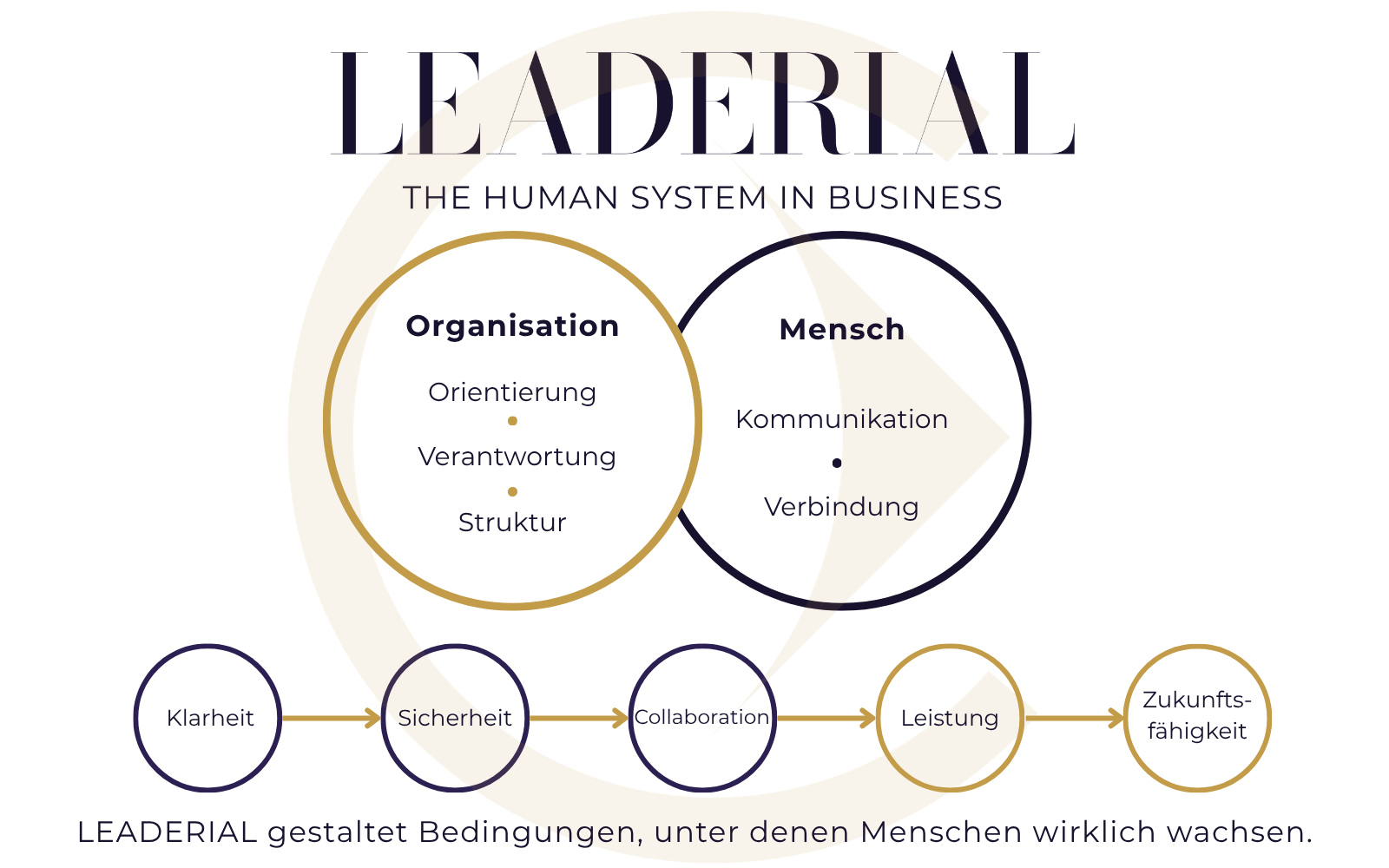
Clarity is the first visible effect of a well-designed system. From clarity comes security, from security collaboration, from collaboration performance — and from that, future readiness.
Clarity→
Security→
Collaboration→
Performance→
Future readiness
LEADERIAL Professional Network
LEADERIAL is growing.
LEADERIAL started as an expert brand and was conceived to be bigger from the outset. A carefully selected network of experienced professionals is now taking shape, bringing together different professional perspectives with a shared understanding of HR and organisational development.
What connects us is a systemic view of organisations, professional substance and hands-on experience. This is how LEADERIAL grows: with people who share the commitment to effective development while contributing their own expertise.
What connects us professionally
The professional basis of the LEADERIAL Professional Network is a university degree in the social sciences or business psychology, complemented by business competence, a systemic way of working and at least three years of relevant professional experience in HR and organisational development.
This combination shapes LEADERIAL's perspective: a sound understanding of human behaviour and social dynamics, paired with a clear view of economic and organisational conditions.
The network connects independent professionals who bring their own expertise and experience. Collaboration takes place on a project basis as freelance work — depending on the assignment, area of expertise and fit.
Do you work freelance in HR and organisational development, share this professional background and recognise yourself in our way of working? Then we should get to know each other.